Showing posts with label newspaper. Show all posts

24 November 2012

Ash Dieback: A Lesson To Be Learnt


Ash dieback devastating our native woodlands: the fault of nurseries importing infected saplings, or the government not acting quick enough? The truth is probably more complex. Despite the bemoaning of the media, it appears they were minor players in the story. The disease was going to arrive here whatever we did or didn’t do. Chalara fraxinea is a naturally occurring fungus; its destructive power is distressing but not unknown in the natural world.

Although humans have not caused it, the appearance of the disease in Britain has shone a torch on our attitude towards trees and woodlands.

Everyone is asking why the ash, of all our native trees, is being imported when it grows here like a weed; a fact I ironically discovered for myself this year. The answer is no doubt complicated with all sides of the argument having their own justifications. In this post I want to look at the practice of mass tree planting. Has the current fashion for planting new woodlands created such a high demand for easily transported and planted trees that we have to import them to meet the need, and has it also simplified our understanding of what a wood actually is?

A wood is not simply a stand of trees, and yet this is what charities are urging us to plant. If we want to do the right thing by the environment, increase biodiversity and reduce carbon footprints, the easy and impressive answer seems to be to plant some trees. After a day's planting, sanctioned and financed by a charity, we look at our field of sticks protected in plastic sleeves and we feel we have done some good.

There are some people, however, in the conservation profession who disagree with this. Although tree planting is well intentioned a more creative and subtle approach to the natural world could be more successful.

A blog post by Habitat Aid, a company selling trees and plants sourced from British nurseries, outlines the concerns:

“1. There is always a tremendous hurry and lack of adequate cash about grant aided planting which means trees are often imported, increasing the danger of spreading pathogens and parasites and reducing the genetic variation of the plant population.

2. Inappropriate tree species are routinely introduced. There’s a “one size fits all” mentality about native tree selection, which seems very odd. In the world of wildflower plants, which shares many of the same problems, we always try to supply seed mixes appropriate to the sites where they will be sown, for example.

3. The groups of trees which are planted do not constitute woods. In particular, no-one bothers to establish an understory, which means they have less value for biodiversity than they should do. Demand for woodland bulbs is amazingly small and their purchase is never covered by woodland planting grants, for example.

4. This issue is compounded by planting densities being too high, which blocks out any light reaching the plants on the ground.

5. We sometimes establish these plantations, with limited ecological value, where more interesting habitat previously existed.”

Andy Byfield in the Guardian talks of the money involved in woodland making:

“An industry has developed around the creation of new habitat in the countryside, yet sometimes it seems more about meeting targets, and holding on to members, selling ecological advice and marketing tree saplings, and rather less about effective conservation.”

And here is dear Richard Mabey being wise:


In this talk he was talking specifically about the current situation of ash dieback. It is here, he says, and there is nothing we can do about it, but there is no need to over-react because ash is “cleverer than us”. Some trees will have a natural resistance to the disease, and through time nature will readjust and accommodate the changes. He believes that relying on stock from uncontrolled nurseries to revive woodland results in plants with a narrow genetic range that makes them more susceptible as a population to disease. He calls them ‘battery saplings’. His answer is to allow natural regeneration to take place. In this way “a self-willed natural woodland” would develop over time.


I understand a conservation industry has to exist. If any good is to be done money has to be involved. Hence there are charities with a need to justify their existence offering easy and attractive solutions, and there are nurseries with a need to make money quickly and cheaply supplying plants. They both improve the environment in some way.

I'm getting that twitchy feeling again though. When money and reputations are involved respect for nature declines. If ash dieback was a fictional story of government neglect, corporate greed and naive hope would the underlying theme be mankind's separation from nature?

I'm going to make a bold move and cancel my monthly donation to The Woodland Trust. It was miniscule. They won't notice the loss. The thinking is that although I fully endorse their work in buying and managing ancient woods I have my doubts about their encouragement of willy nilly planting.

The charity that gets my tiny contribution next year will either be Plantlife or Buglife. What do you think?


28 October 2012

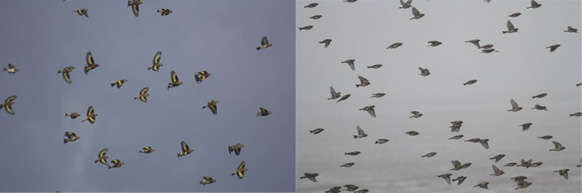
Autumn Migration of Garden Birds. A Sad Story

Images from Spurn Bird Observatory


I am aware this blog is where I routinely reveal my ignorance of the natural world, but today’s disclosure is damning ... I didn’t know garden birds migrate across the sea.

Yes, I knew of heroic geese and astonishing swallows, and David Attenborough has explained the epic journeys of arctic terns a number of times, but I didn’t realise little suburban brown birds fly across the North Sea and English Channel. When they disappear from my garden after producing the year’s chicks I thought they simply left the city to live a less pressurised life in the surrounding countryside. I had visions of them chirping in a hedge in Alderley Edge; never thought they were eating worms in Worms (see what I’ve done there?). Admittedly my Mancunian robins may be doing just that, but many, many garden birds arrive on British coasts during the autumn months.

As an example here are reports from Spurn Bird Observatory on the Yorkshire coast:

23rd October

“14 Woodcock, 8 Swallow, 5 Rock Pipit, 5 Grey Wagtail, 1 White Wagtail, 700 Robin, 14 Black Redstart, 1 Redstart, 1 Whinchat, 5 Stonechat, 1 Wheatear, 43 Ring Ouzel, 1250 Blackbird, 1580 Fieldfare, 80 Song Thrush, 1870 Redwing, 4 Mistle Thrush, 14 Blackcap, 61 Chiffchaff, 1 Willow Warbler, 515 Goldcrest, 1 Spotted Flycatcher, 2000+ Starling, 44 Chaffinch, 367 Brambling, 7 Siskin, 3 Lesser Redpoll, 1 Lapland Bunting.”

I’m shaking my head with wonder. 515 Goldcrest! 700 Robin! 1250 Blackbird! I didn’t know.

Unfortunately, this new nugget of knowledge entered my consciousness for a sad reason. On Friday the RSPB reported fishermen on the south coast had seen tired birds struggling across the sea with many not making it at all.

“An appalling combination of fog and winds around England’s coast this week have created terrible conditions for migrating birds, with some fishermen reporting to the RSPB the deaths of many exhausted and disorientated ‘garden’ birds plunging into the sea around their vessels.”

“One respondent, a professional boat skipper, said: “While fishing about 10 miles south of Portsmouth, we witnessed thousands of garden birds disorientated, land on the sea and most drowning. Species included goldcrests, robins, thrushes and blackbirds. The sky was thick with garden birds. I estimate I saw 500 birds die and that was just in our 300-yard sphere. On the way home we just saw dead songbirds in the water: it was a harrowing sight.”

“Martin Harper is the RSPB’s conservation director. He said: “The scale of these reports are truly shocking, and it has the potential to adversely affect the status of species which may be declining for other reasons.”

This is the official account of what had happened, presented in a neat easily understood fashion. I notice the news has got to the other side of the world, with it already being reproduced in Australian news. The overall story is of bad weather – climate change – yet again devastating populations of vulnerable animals. It is interesting that this news story coincides with the wider media getting hold of the ash-dieback story. Sadness upon sadness. “The end of the world is nigh”.

But what of the hundreds of birds coming across the North Sea without any apparent problems?

Putting my ‘I Know Nothing, But ...’ hat on I wonder whether what was admittedly a tragic event on the south coast in reality counts as a normal occurrence for birds every year and throughout the world. Fog and high winds have always occurred in autumn. Evolution has engineered it that in autumn birds fly across the sea to Britain to escape the cold continental winters. This has been happening ever since woodland birds have existed in Europe. For 10,000 years?

Here is what actually happened in the words of some of the fishermen who witnessed the event (found on The Solent Fishing Forums).

23rd October
“The fog and mist must have completely disorientated then as they were flying in all directions and some of them were completely knackered flying very close to the surface of the sea.

Several landed on the boat, we had goldcrests, thrushes, blackbirds, fieldfares and robins all over the boat, sitting on rods and anything they could get a purchase on.

The sad thing was a large number did not make it and we saw loads going into the sea, while trying to get to the boat, and struggling on the surface before succumbing to the sea and drowning. It was pretty awful to watch and there was nothing we could do.”
Source

“Was a shame about the little birds we had them landing all over us as well, also saw them landing on the water for a rest with there wings and tail feathers spread out then would take off again a short while later, didn't see any drown.”


25th October

“For anyone with concern for birds it was a dreadful day, to see the poor little blighters go into the sea was quite distressing. They were being attacked by the gulls as well so they stood little chance.

There was also Gold Crests, Willow Warblers and Starlings in trouble.”
Source  (face blanked out for privacy)


Certainly sounds horrible doesn’t it? And these are men with a firsthand knowledge of nature. Again ‘I don’t know’ but I would imagine they’ve seen some disturbing things while out at sea and wouldn’t be so bothered. In fact one contributor to the forum said, “get a grip of ya’self boys.” But then came the shell-shocked reply:

“You had to be there to see it for yourself, it was not something I would like to see again.”

It must have been a terrible thing to see. One of the fishermen on the forum said he had contacted the RSPB and got a reply. Compare what they said to him to the words of their official news report.

“Many Thanks for your enquiry, we have had a number of reports of this.

At this time of year the UK is receiving a large amount of migratory birds fleeing colder weather in Europe and heading to the UK to spend the winter, most of these birds will not be resident UK birds but European breeders so the effect would probably be more devastating to Europe, however most of the birds you mention are not of conservation concern and their numbers are doing really well so hopefully this will not make too much a dent in population numbers.

Obviously what has happened here is extremely devastating for each individual bird, these birds must have become disorientated (due to the weather) during their migration and struggled to find land, exhausted they must have simply given up which is a real shame, the good news is that all over the country on our coastal reserves are reporting many thousands of Thrushes, Goldcrests, Robins etc turning up which suggests that many have made the migration and are doing ok.”

An interesting contrast isn’t it?

What I get from this episode is that Nature is a force that inexorably moves through the world indifferent to the concerns of humans, be that fund chasing charities, sentimental fishermen, or ignorant gardeners ... or little brown birds.

RSPB report
The Solent Fishing Forums
Photos of Birds At Sea

29 July 2012

Of Snails, Sex and Soul


[To increase Pea Quiz fervour I'll keep the answer until later in the week]

You know that disappointing moment when you realise you’ve finished reading all the newspaper articles you intended to, and you should now get up and do something domestically more productive, but you find yourself in the grip of a tea-and-biscuit fuelled inertia that whispers ‘the ironing can wait, read another section’? This Saturday morning surrounded by a litter of discarded newspapers and lulled by the rhythmic strokes of Olympic rowers (on the TV) I had one of those moments. I turned over the unread sections. Travel? Not likely in the present economic climate. Property? Ditto. Telegraph Weekend? Sounds harmless enough.

Inside I was surprised to find, hidden amongst the stair lift and recliner adverts, the fierce Germaine Greer, and that she had written an interesting article on snails. “My one-acre wood is festooned with them.” Unexpected.

The article is efficiently written covering little known facts and literary associations. She has done her research and expresses sympathy for the delicate creatures. Nothing revolutionary or challenging there at all. But us ‘Female Eunuch’ graduates need not worry that her fighting spirit has diminished with age. In looking at the contribution of poets to snail related literature she says tartly of a Thom Gunn mollusc,

“His snail is male and predatory. The image tells us more about the poet than it does about the snail.”

Good old Germaine!

Here is the poem in full, called ‘Considering the Snail’,

The snail pushes through a green
night, for the grass is heavy
with water and meets over
the bright path he makes, where rain
has darkened the earth’s dark. He
moves in a wood of desire,

pale antlers barely stirring
as he hunts. I cannot tell
what power is at work, drenched there
with purpose, knowing nothing.
What is a snail’s fury? All
I think is that if later

I parted the blades above
the tunnel and saw the thin
trail of broken white across
litter, I would never have
imagined the slow passion
to that deliberate progress.

Germaine objected to the notion that the snail is hunting, and that he moves in a ‘wood of desire’. Until today I didn’t know anything about Thom Gunn, but apparently he was a Cambridge educated homosexual Englishman who enjoyed an LSD fuelled 1960s in the Californian sunshine. Good for him. Is there a hidden agenda to Germaine’s sniffy distain of his snail? I wonder if they were contemporaries and she felt obliged to develop a resistance to his celebration of maleness.

You have to be careful how you interpret poems. The poem does have sexual undertones – gay or heterosexual, but I think it would be too easy to dismiss it as simply erotic. Poets are clever people; they know how to weave many meanings into what at first looks plain.

What strikes me in this poem is Gunn’s Wordsworthian awe of the power of Nature.

“I cannot tell / what power is at work, drenched there / with purpose, knowing nothing.”

It seems to me that he is saying this brainless animal, who doesn’t read newspapers or write blogs or believe in any ‘isms’, who knows nothing, still has a determined purpose. ‘What is a snail’s fury?’ he asks. What drives it? Where does it get its passion from?

In another poem, ‘On The Move’, he describes a group of leather-clad bikers bowling through the countryside,

They scare a flight of birds across the field:
much that is natural, to the will must yield.
Men manufacture both machine and soul,
and use what they imperfectly control
to dare a future from the taken routes.

***
the self-defined, astride the created will
they burst away; the towns they travel through
are home for neither bird nor holiness,
for birds and saints complete their purposes.
At worst, one is in motion; and at best,
reaching no absolute, in which to rest,
one is always nearer by not keeping still.

OK we’re moving away from snails here. However, I think it continues his observation on the difference between humans and the natural world. Men manufacture soul and imperfectly use it to seek meaning, whereas birds (not sure about the saints) are already complete and free from restlessness. Bird and snail don’t think, they just Be. Man has a mind and a will which only leads to discontent.

Who would have thought The Telegraph would stir up such existential musings?

Here is a link to Thom Gunn reading his snail poem. He had a lovely voice.

5 June 2012

How Insects Can Fly In Rain


Do you think that was summer? The rain seems to have come back, and it’s colder. The garden is struggling on but the few seedlings and young plants I’ve brought in seem reluctant to grow. They are like people waiting at a bus stop in the rain. As soon as the bus – sunshine – comes they will be off, but until then they’re shuffling their feet and playing with their I Phones.

It’s noticeable that when the sun does appear the garden is suddenly full of insects again. I wonder where they go and how they survive when the conditions are bad. Do they hide away in dark crevasses or under leaves and spend the time muttering to themselves about British weather? Being cold blooded the air temperature must have something to do with it, in that they simply can’t move until it warms up again. And the rain itself must be a factor. It must be impossible to fly while it’s raining when each rain drop is the same size as you. Just imagine walking around while trying to dodge huge six foot wide blobs of water. It would be like a scene from The Prisoner. And water is heavy stuff; those blobs could knock you out if they fell on you.

There is no wonder insects don’t venture out when it’s raining ... or is there?

Some American scientists have been looking at how mosquitoes survive the impact of raindrops which are up to fifty times heavier than they are. Slowing down the collision using high speed filming techniques reveals not a violent struggle but an elegant dance. As both mosquito and raindrop fall through the air they join together and continue to fall some distance before the hairs on the insect’s body repels the water and they separate to continue on their own paths. One of the researchers, a Dr Hu (say his name out loud – it’s funny) compared what happens to the principle of non-resistance which many Eastern philosophies advocate.

"There is a philosophy that if you don't resist the force of your opponent, you won't feel it," he explained.

"That's why they don't feel the force; they simply join the drop, become one item and travel together."

I like this conclusion from the report abstract:

Our findings demonstrate that small fliers are robust to in-flight perturbations.

So here’s the life lesson we can learn from mosquitoes:

To avoid perturbations go with the flow.


Main article from BBC Nature

24 May 2012

Ahead Of The Game


Goodness I’m good at this nature blogging lark. Two articles in today’s newspapers touch on topics I’ve already written about. They have, however, expressed them far more eloquently than I, but still, it’s nice to be part of the zeitgeist.

Today in The Independent Michael McCartney reveals his passion for butterflies but worries these days this may be seen as a little ‘soft’.

“For a start, professing such an enthusiasm runs counter to the prevailing tone of our age, which is subversive. We like statements to be wry, knowing or ironic, we like them to be cool, so something as pathetically simplistic as an open admiration of natural beauty is just asking to be shot down”

Yesterday I said,

“I wonder if it is because their [ie. butterflies] beauty lends them an aura of femininity, which encourages uneasiness in reporters and campaigners.”

It is certainly interesting that a high profile reporter of the natural world is feeling the same thing. He goes on,

“Further, I think that admiring beauty has become itself suspect. Beauty is regarded as elitist: why bear it such tribute when so much more of the world demands our attention?”

Again I agree. For some time I have been wondering why the public are being urged to grow vegetables in their gardens. Yes, it’s a fun thing to do, and veg. grown in your own garden tastes far superior to that bought from a supermarket, but what is wrong with spending your efforts on creating beauty and peace in your own garden? It is as if we must atone for having the good fortune in having a garden by making it useful; making it pay its way. Valuing normal suburban gardens in terms of functionality alone is a dangerous path to travel.


My other insight involves teabags. We may not be able to save the world by growing vegetables but we can by putting our teabags in the green bin.

The Guardian reports that Unilever, who make PG Tips, have teamed up with the recycling organisation Wrap to promote a campaign in Chelmsford and Brentwood Councils to encourage people to compost their teabags or put them in the recycling bin instead of chucking them in the general bin which goes to landfill.

If you recall from my post on food waste (I know you pay close attention to every missive) I did find teabags were the major occupier of my little kitchen top box. They take up the greatest volume and weight of any other food item thrown away.

Of course I’m now feeling smug because I do the ‘right’ thing with my teabags, but let’s face it, redirecting teabags is a much easier than growing veg.

20 May 2012

The Reality of Urban Wildlife


Yesterday The Guardian (I live in Didsbury, of course I read The Guardian!) published a little supplement called ‘A Spotter’s Guide to Urban Wildlife’, when however I’d finished reading it I wasn’t sure why they had produced it. The Introduction declared,

“we aim to prove that wildlife doesn’t simply survive in urban areas, it thrives.”

The author Stephen Moss explained how Britain’s population became predominantly urban with the industrial revolution, claiming our agricultural labouring ancestors, ‘ certainly had little time for the appreciation of nature we take for granted today’, but now the farming landscape is ‘a green desert’ and cities contain many species of wildlife ‘we and the wildlife are together again.’

Then an artist told us insects are all around us, even if we live in the city. We were also encouraged to look for grass snakes, Atlantic salmon, otters and stag beetles.

Two articles did stand out for me as engaging with the realities of urban nature. The ‘urban birder’ David Lindo works in cities and has made a study of the birds on Wormwood Scrubs. His advice is to simply look up – even while watching football at Old Trafford he has seen cormorants fly over. Chris Baines made a good point, I thought, in that the richest part of an ecosystem is ‘on the edge’, and that suburban gardens are by definition ‘edges’ of hedges, fences and boundary trees.

I am uncertain about this supplement because it seems to be an exercise in naming animals (note there is no mention of plants – weeds not interesting enough?) and a little light self-congratulation in that ‘we now care more about our natural neighbours than at any other time in our history’. Is the existence of foxes and parakeets in city centres really proof of a thriving wildlife population?

To seriously examine urban wildlife the first step would surely be to define ‘urban’. The word covers Georgian/Victorian city centres including retail and business centres, twentieth century suburban housing sprawl, industrial brownfield sites, canals, railways, parks, and according to this supplement, the river estuaries where commercial shipping still happens. These are all different habitats in which different animals can exist. It is a more complex issue than simply urban versus countryside.

A genuinely useful guide to spotting wildlife in these environments would then consider where people would be likely to come across animals. My dad used to work in a grain mill; he saw giant rats and hundreds of pigeons. I’m sure my mum saw her fair share of silverfish in the stockrooms of the shops she worked in, and I’ve never seen spiders as giant as those living in the heat behind computers.

And here I’m finally getting to my point: the day to day reality for the majority of people when considering wildlife is not hedgehogs at the bottom of the garden or newts in the pond, it’s mallard ducks on the park pond, mice in the cornflakes, slugs on the garden path, and dead moths in their light fittings.

I would like to see a publication that explains these creatures to me. Many environmentalists, including the saintly David Attenborough, say they started their interest in the natural world by looking at the small things in their immediate surroundings. Perhaps this would be a better place to start if the younger generation, and us more advanced in years, are to be encouraged to care about ‘our natural neighbours’.

Trouble is, it’s not something I’d want to read over my Saturday morning cappuccino and Marks and Spencer chocolate biscuit.


22 April 2012

Peat Compost - The Wrong Answer


In her Observer column, ‘Ethical Living’, Lucy Siegle defends the use of non-peat based composts in gardens because the cutting of native peat bogs is ‘destroying our most effective carbon sink (a reservoir that removes CO2 from the atmosphere)’. The simple equation is that the more carbon in the atmosphere the warmer the climate gets, the more trouble there is for humans. This is a scientifically agreed process, and would surely be enough reason for an ‘ethical’ gardener to stop using peat.

But this doesn’t answer the reader’s question:

“My garden supports more life than it destroys, so I see no reason to stop growing with peat products (the best). Gardeners are being unfairly targeted.” Alasdhair, Kent

Alasdhair, I guess, is talking about diversity, another issue entirely. The richness of an environment is a measure of its success as an ecosystem. An environment with limited flora and fauna is unstable and vulnerable.

The argument being implied is that the use of peat compost allows a greater variety of plants to grow than in a similarly sized area of bog. There may also be some thought to the number of birds and insects those plants attract. If you look over any cultivated garden it will be evident it hosts many types of plant from alpine flowers to Mediterranean grass to South American fuchsias. Research done by Sheffield University has shown plant diversity is indeed high in gardens, possibly even greater than in tropical rain forests.
“The world record for plant diversity remains unknown, but is almost certainly held by a garden somewhere.”

The key, however, is that word ‘cultivated’. A garden is a reflection of the gardener. It lasts as long as that human lives in that house attached to the garden. It may even be limited by the fleeting whim of the owner, her physical ability to get outside, or her disposable income. The plant diversity within the piece of land at the back of a house can only be maintained with effort.

And yet as a rebuttal to my argument, in a finding that bursts the egotism of the gardener, the Sheffield researchers found gardens were similar, with regards to species numbers, to urban derelict land, and much of the richness in the garden came from opportunist weeds growing on bare earth between cultivated plants.

So, Lucy, the answer to the question is, yes, Alasdhair, the peat you are using IS supporting ‘more life than it destroys’, BUT for how long and for whose benefit? You may be enjoying your green and colourful plants but what of the rest of us and our children and grandchildren and ...?

Urban gardens however much we love them are artificial and short-lived phenomena. Nature doesn’t need us ... in the long term.


Original Observer article
Sheffield University research into diversity in urban domestic gardens

Image by  Philip Precey from Yorkshire Wildlife Trust site