Showing posts with label vegetables. Show all posts

7 June 2015

Non Sum Qualis Eram

natural dye artichoke

This post is a cautionary tale travelling from the heights of Mount Olympus via some impassioned Decadent poetry, with a detour to the Deep South of the American Civil War, to end ignobly with a snarling dog.

It begins mundanely with a bored housewife picking snails off the leaves of a globe artichoke. I wonder, she muses, if these leaves can produce a dye. Within a couple of hours she had the answer: yes, they can, an impressively deep yellow.

In her little world this is an exciting discovery. She looks up the scientific name of the artichoke to see if it belongs to a family of other plants who may be similarly generous.

Cynara scolymus
Digging deeper she finds a tragic legend attached to the Cynara family.
"According to Greek myth" - and here the cautionary bit of the tale begins - Cynara was a beautiful maiden living on the island of Zinari.  Zeus, who was visiting his brother Poseidon,  saw her and fell in love. He made her a goddess [the Jungians and feminists amongst us will no doubt have words to say on this story] and brought her up to Olympus. However, sensible woman, she missed mortal earth and would sneak back down when he wasn't looking. When he found this out he got cross and turned her into an artichoke. Not one of his most imaginative efforts, I'd say. Not his usual swans, willows, or fawns, but there you go.
This story is repeated whenever someone writes about artichokes. Go see for yourself ...
Sniffing out a possible blog post the housewife searched online for the original Greek telling of the tale, but couldn't find it. No matter, maybe it is not important enough to appear in the first few pages of a Google search. What did turn up was the Roman poet Horace bewailing someone called Cynara.

After a long cessation, O Venus, again are you stirring up tumults? Spare me, I beseech you, I beseech you. I am not the man I was under the dominion of good-natured Cynara. Forbear, O cruel mother of soft desires, to bend one bordering upon fifty, now too hardened for soft commands:

The gist is he has seen an attractive young man, and felt  'tumults' stirring, but at nearly fifty thinks he hasn't the energy to pursue them, since he is not the same as when he knew good-natured Cynara.

Ask Me No More by Alma Tadema


Who was Cynara? Did she resemble an artichoke in any way?

Who knows.

Two thousand years later Horace's lament inspired another male poet to muse on the nature of love. Ernest Dowson, a Decadent poet, wrote 'Non sum qualis eram bonae sub regno Cynarae'. The title translates as 'I am not as I was in the reign of good Cynara'.  The gist is he is with a red-lipped woman and suddenly remembers lily white Cynara.

But I was desolate and sick of an old passion,
    When I awoke and found the dawn was grey:
I have been faithful to thee, Cynara! in my fashion
Maybe being associated with a vegetable is not such a bad thing. That's three men with fond memories of Cynara.
At this stage in the cautionary tale a web of romance has woven around our Artichoke.

To weave another thread we can take a detour to Vivien Leigh's heaving bossom.

The title of the book Gone With The Wind was taken from a line in Dowson's poem:
I have forgot much, Cynara! gone with the wind
The author Margaret Mitchell was touched by the "far away, faintly sad sound" of the line.

But this has nothing to do with Artichokes.

Back to the scientific name Cynara scolymus

And here the romance comes to a juddering end.

'Cynara' is an amalgam of the Latin word for canine and the Old Greek word for dog, 'kyon'. The 'scolymus' element relates to words such as spiny and thistle.  These descriptive words are referencing the dogs tooth like spines on the stem of the plant.

Dog Tooth Spines on Artichoke
Plus Pesky Snails

So we seem to have been led down the wrong path. Artichokes are not associated with a mistreated woman, but sharp dog teeth.  Our English word artichoke probably comes from its original Roman (latin) name for cardoon, a similar vegetable.

The caution here is to beware what you read. If something gets repeated enough it becomes fact. 'According to Greek myth' is a phrase best taken with a pinch of salt.


8 December 2012

Vegetable Knowledge

Virginia Woolf in a great hat with Angelica Bell

 I'm a bit miffed that I've not posted for a while. I haven't managed to keep up with the self-imposed posting schedule of one every other day. Of course, winter would always be a challenge, what with it being the season of hibernation and dormancy, but that is not the only reason for the lack of posts.

The room with the big computer on which I prefer to work, because it has a wide screen and comfy chair, is cold and dark. It is where the permanently loaded clothes horses are kept and is crammed with folders and books, a sewing machine, bags of scrap material, boxes of paints and past art projects, the 'to be ironed' pile, and the 'only used on Sundays and Christmas day' dining table. The room is not nice, and nowhere anyone would want to spend an afternoon.

It is telling that nearly a century after Virginia Woolf noted women do not have enough power in their homes to claim a room for themselves the situation remains. I know of other women who have to practice what is important to them in the smallest, darkest, most awkward room in the house.

But enough feminist musings ... let me tell you of my new vegetable knowledge.

The organic growing course in Debdale has been very enjoyable and inspiring. Lately we have been learning about sowing seeds and transplanting seedlings. I'm a dab hand with a dibber now.

Now don’t you go thinking vegetable growing a dull topic – the other week I was shocked to my core, and still haven’t quite recovered: leek seedlings are planted in holes in the ground and NOT covered over with soil! They seem so thin and vulnerable to be treated this way. My mothering instincts are yelling ‘won’t someone protect the leeks?!’

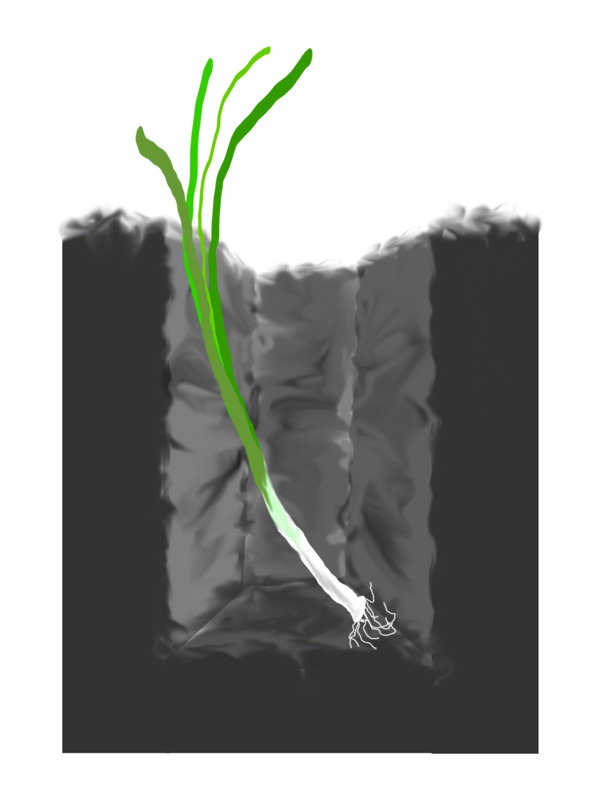
leek seedling planting out
A deep hole is dug and the little leek is popped in.


Watering it swishes some earth around its base, but otherwise it is left to fend for itself.
Of course the reason is to encourage the growth of the white bit.

diagram of leek inside loo roll holder
Another method is to plant them out inside loo roll holders to keep the stalks straight and white.
Interesting. Might try this in Allotment 90.
Less shocking but equally intriguing are carrot seedlings. Did you know it is recommended that you plant the seeds directly into the ground rather than germinating the seeds in trays? This is because there is a danger of damaging the root when you wrestle the tiny seedling out of its cell and man-handle it into the ground. If it is broken the adult root will grow gnarly with a likelihood of a photo of it being uploaded onto Facebook as yet another 'rude vegetable'.
diagram of carrot roots
 And my final piece of ignorance is potatoes. I didn't know until this week that new potatoes grew from the stalk of the plant and not the original seed potato.


16 November 2012

Veg Plotting

Garden65 drawn to scale

The homework this week on the vegetable growing course was to draw our ideal vegetable patch. The first lesson was about planning, so this is an exercise in measuring and deciding what plants go where.

Some people on the course have allotments of their own, and others, like the student, have no access to land at all. I'm in the middle: I have land but don't plan to plant vegetables on it in any volume (not counting the odd tub of tomatoes). However, I thought I'd go with the flow, throw caution to the wind and pretend that I was indeed going to take down all my beloved plants, rotovate the ground flat and turn Garden65 into Allotment65.

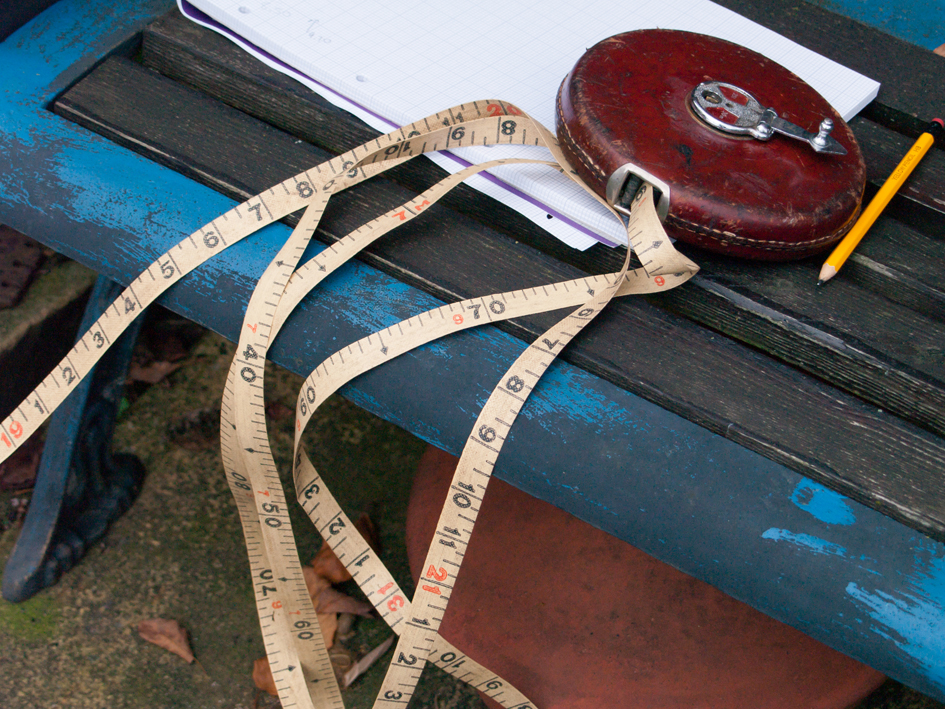
Step 1 is measuring out the plot. Luckily, hidden in the back of a cupboard, lurks a 30m measuring tape, the kind used by officials wearing blazers and panama hats to measure the efforts of javelin or discus throwers. I got it at a car boot sale many years ago. Not sure why. I liked the leather case, and it reminded me of school sports I suppose. Who thought a decade later it would actually be put to use?


It turns out Garden65 is about 10m long and 9ish m wide. It was good fun squeezing under shrubs and threading the tape through branches, but I'm hoping accuracy isn't important and that 'ballpark figure' is what we are after.


The measurements were plotted onto graph paper. I realise this isn't a genuine map of the ground. The perimeter is surely not a neat rectangle; the reach of the tree canopies were estimated by me lying on the ground, with the tape in my hand, looking up to find the tips of the longest branches; and measuring the little pond was too daunting, so it's represented by a pond-shaped blob instead.


The result after many sweary hours at the PhotoShop coalface is the neat diagram at the top of the page.

And with the swish of a magic wand here is Allotment65:


The decking has been sacrificed for a greenhouse; the problematic little pond is abandoned to the bees; a seat to drink coffee on is too important not to be included; and the 3 sisters have their own bed.

As for the crops there are two problems, apart from general ignorance (and naivety?). One is my family consists of two teenagers and a hubby from Wigan. Consequently we don't consume a great variety of vegetables. Think frozen peas and pounds of potatoes. Any romantic dreams of overflowing beds of pak choi, Jerusalem artichoke, and chard have to be abandoned. Thus the list of vegetables to play with is limited. Another issue to grapple with in this make believe allotment is that although it is south facing only the middle gets sunshine all day. What do you grow in shaded areas?

This is reminding me of maths homework when I was at school. I've learnt the formula but can't make the equation work so I'm going to hand this plan in to Marva but am expecting a B- at best.

This was an enjoyable exercise. I know my mum will be laughing because I used to do this kind of thing when I was young, although it wasn't gardens I was planning then but riding stables and zoos. However, it does highlight the limitations of transferring the real world onto squared paper, and reinforces my twitchiness about garden designers. Wielding a pencil and ruler creates a seductively organised picture, but this is an illusion.  A plan is only an approach, a starting point. The real journey begins when spade is dug into soil.

With this in mind I WILL BE MAKING A SURPRISING AND WONDERFUL ANNOUNCEMENT SOON. Watch this space.

14 November 2012

The De-o-ha-ko In Debdale


The gradual absorption into the gardening fraternity continues: I have begun an organic vegetable gardening course.

Hurrah.

I’ll tell you more about it later, but for now here's something I came across last week.


The course is in Debdale Ecocentre. The leader, my new gardening crush, Marva, began by showing us round the raised beds and poly tunnels of the centre. She explained normally the crops would have been harvested by now but she had been keeeping them back to show us what the centre grew. So in the poly tunnels were rich displays of tomatoes (still green), vibrant salad leaves, an overwintering wormery (got to get myself one of those), and neat beds demonstrating companion planting. Outside the ground was barer but there were still little leeks, beetroots, turnips, and a bed with the Three Sisters growing in it.

The Three Sisters? These are corn, beans and squash all grown close together. The beans twine themselves up the corn and the squash covers the ground. This system of three plants is an amazingly efficient example of companion planting. The corn supports the bean plants, which in turn fix nitrogen in the ground for the benefit of the corn, and the wide leaves of the squash act as a mulch to suppress weeds and keep in moisture. Not only that but eaten together they make up a complete protein meal.

The name ‘The Three Sisters’ was given to this scheme by Native Americans. We generally think of them as bison hunting warriors but forget they existed for many thousands of years by growing crops. The Navajo and Cherokee farmed at the same time as they were chasing John Wayne. The staple crops of corn, beans and squash were so important to them they wove them into their creation myth.

“The term “Three Sisters” emerged from the Iroquois creation myth. It was said that the earth began when “Sky Woman” who lived in the upper world peered through a hole in the sky and fell through to an endless sea. The animals saw her coming, so they took the soil from the bottom of the sea and spread it onto the back of a giant turtle to provide a safe place for her to land. This “Turtle Island” is now what we call North America.

Sky woman had become pregnant before she fell. When she landed, she gave birth to a daughter. When the daughter grew into a young woman, she also became pregnant (by the West wind). She died while giving birth to twin boys. Sky Woman buried her daughter in the “new earth.” From her grave grew three sacred plants—corn, beans, and squash. These plants provided food for her sons, and later, for all of humanity. These special gifts ensured the survival of the Iroquois people.”

The sisters were seen as protective spirits and called De-o-ha-ko, (pronounced Jo- hay- ko) "our supporters."

Now this is the kind of information that motivates me to grow veg. Forget utopian sustainability nonsense. A pinch of science, ancient history, and a story that involves a turtle. That'll keep me in the fraternity - or should that be sisterhood?

Source of story